You can't save on overhead you weren't paying
A line about Claude Code’s new Dynamic Workflows kept showing up in my X feed: “orchestrate agents in parallel while your session stays free.” I run a four-role agent methodology — Anchor, Architect → Implementer → Reviewer → Memorial — so the framing read like it might erase the coordination overhead I’d been paying for. I built a proof-of-concept and measured it.
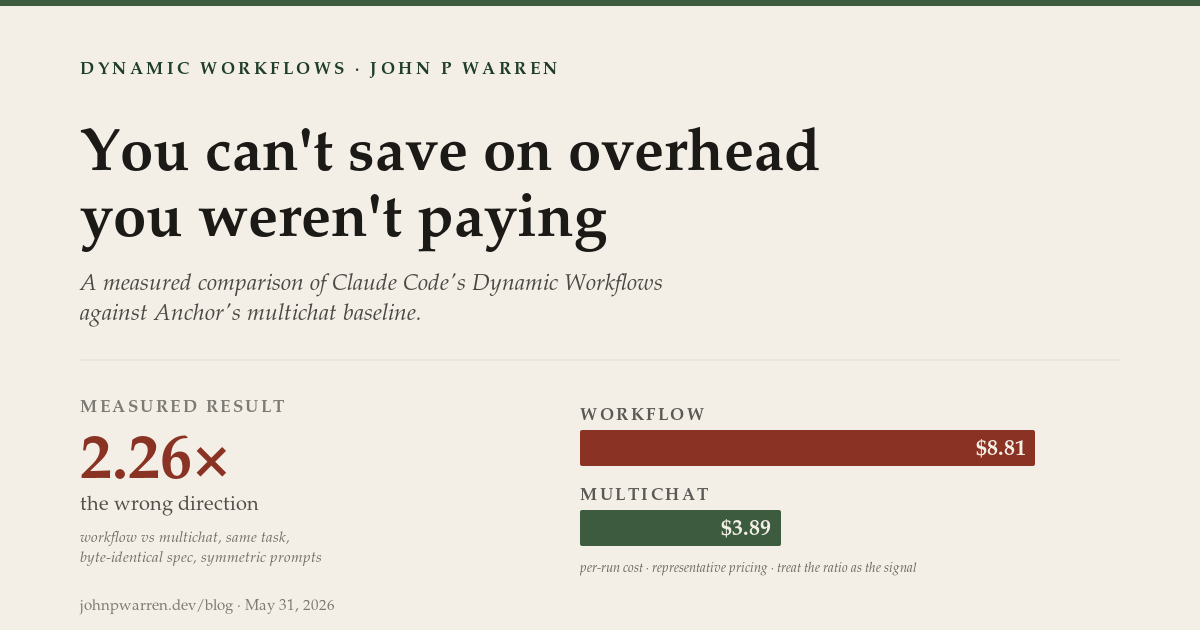
The workflow cost about twice as much as the same task run through Anchor’s normal multichat mode. The deeper finding, which the architecture made inevitable: there was never a saving available. You can’t save on overhead you weren’t paying.
One disclosure, since it’s load-bearing. I wrote Anchor. An “Anchor wins” conclusion from Anchor’s author is worth nothing unless the evidence is adversarial and the caveats are honest. This post leans on Anthropic’s own documentation, hands you the raw numbers with their warts, and includes the part where I caught myself overstating an earlier result. Judge it on that.
”Free” is doing a lot of work in that sentence
Here is the whole misread, and it’s a community read of the docs, not Anthropic’s own announcement. The official launch leads with “hundreds of parallel subagents in a single session” and verification of outputs — scale and rigor, not no-cost magic. The “free” language sits in the docs, on the same page as the cost warning. There, free and responsive get used as synonyms:
“a runtime executes it in the background while your session stays responsive.”
“agents work through a set of phases in the background while your session stays free…”
“Workflows run in the background, so the session stays responsive while agents work.”
“Stays free” means your session is free to keep working while the run executes elsewhere. It’s a statement about not being blocked. There is one real resource that genuinely stays free — your main conversation’s context window, because intermediate results live in script variables instead of piling into the chat. But context is not cost. The agents still spend the tokens.
On cost the docs are explicit, in a section the screenshots never include:
“A workflow spawns many agents, so a single run can use meaningfully more tokens than working through the same task in conversation. Runs count toward your plan’s usage and rate limits like any other session.”
Anthropic’s announcement optimizes for parallel and verified. The docs add responsive alongside probably more expensive. The community pulls responsive forward to free of charge. All three are visible in the source material; the misread happens at the third step.
What the primitive actually is
Per the documentation: a Dynamic Workflow is “a JavaScript script that orchestrates subagents at scale. Claude writes the script for the task you describe, and a runtime executes it in the background while your session stays responsive.”
The genuinely good ideas:
- The plan moves into code. With subagents or skills, the model is the orchestrator — it decides turn by turn what to spawn, and every intermediate result lands in its context. A workflow script “holds the loop, the branching, and the intermediate results itself, so Claude’s context holds only the final answer.”
- Scale. Dozens to hundreds of agents per run, far past what one conversation can coordinate.
- Background execution, so the session isn’t blocked.
- Repeatability and resume. The orchestration is a script you save, rerun, and resume mid-flight.
- Quality patterns. It can have independent agents adversarially review each other’s findings before they’re reported.
For a 500-file migration, a codebase-wide bug sweep, or a research question that needs many sources cross-checked, this is the right tool. Hold that thought; I come back to it.
What I measured
I ran one round of the Anchor cycle as a single Dynamic Workflow against a small, known-good benchmark: implement compareSemver(a, b) to the semver.org §11 precedence spec, with tests. Two arms, same task:
- Arm A — the workflow. One script, four
agent()calls, Architect → Implementer → Reviewer → Memorial, run by the workflow runtime. - Arm B — Anchor’s normal mode. Four independent role agents, coordinated the way Anchor coordinates today — separate sessions, artifacts passed between them.
Both arms ran the same disciplines: cold-context separation, pre-emit grilling, an adversarial cold-eye Reviewer. I reconstructed real per-role cost from the agent transcripts, because the live cost API only exposes output tokens — the full prompt/cache/cost breakdown has to be dug out of the logs. That’s a finding in itself.
The first result was wrong
The first run came in around $9.26 for the workflow against $5.85 for multichat — roughly 1.6×. I started writing it up. Then I ran an adversarial audit of my own measurement, the way Anchor’s Reviewer audits an Implementer. It found a killer confound: the two arms had each generated their own spec, and the workflow re-threads spec text through later role prompts. A larger Arm-A spec inflated Arm-A cost through the exact mechanism I was about to blame.
The audit’s verdict was blunt. The data was enough to retire the “5–10× cheaper” hope — no saving appeared in any direction — but not enough to assert the inverse multiple. I had been one paragraph from quoting a number my own method couldn’t support.
The fixed result
I re-ran with one byte-identical spec, fed to both arms by the same path, symmetric prompts, only the orchestration substrate differing. Representative pricing — treat the ratio, not the dollars, as the signal:
| Workflow | Multichat | Ratio | |
|---|---|---|---|
| cost (USD) | 8.81 | 3.89 | 2.26× |
| completion tokens | 19,478 | 9,432 | 2.07× |
| cache-creation tokens | 233,727 | 107,819 | 2.17× |
Fixing the confound didn’t rescue the workflow. It widened the gap.
Caveats, because full receipts means the unflattering ones too
- N = 1, on one small task. “Holds on
compareSemver” is not “holds on a 40-file refactor.” - Arm B is a proxy for multichat: independent subagents, not four literal human-driven chats. The proxy omits the human’s back-and-forth turns (which would push multichat up) but enjoys lean curated inputs (which push it down).
- A real bug in my harness — the workflow agents ignored the output paths I gave them and scattered files — made the Reviewer hunt around and inflated its cost. I can’t fully separate that artifact from genuine substrate overhead.
Trust the direction and the refutation, not the exact multiple. Even with every honest correction, no version of this turns a 2× deficit into the 5–10× surplus the optimistic reading needed.
Why no saving was ever on the table
The number isn’t the interesting part. Why there was no saving available is.
A Dynamic Workflow’s real efficiency win is deleting an LLM orchestrator’s coordination tokens. If your alternative is a manager agent that reads everything and reasons, in tokens, about what to dispatch next, moving that plan into free-running JavaScript is a genuine saving. That’s the case the primitive was built for.
Anchor’s orchestrator was never a model. It’s a human routing between chats, or a file-driven state machine (NEXT-ROLE.md) in automated mode. Both cost zero model tokens. The workflow replaces a free orchestrator with a free orchestrator — and then adds overhead: each role’s agent re-pays for context, threaded forward in prompts and re-read on every tool-use turn. You’re paying to remove a cost you didn’t have.
And the headline word — parallel — never applied. Workflows earn their keep on fan-out; the docs’ own examples are “a codebase-wide bug sweep, a 500-file migration.” Anchor’s cycle is a dependency chain: the Implementer needs the Architect’s spec, the Reviewer needs the implementation. You cannot parallelize a sequence. The primitive’s signature strength was structurally unavailable before the first token was spent.
One more, dispatched: even the genuine “your context stays free” benefit isn’t an edge over Anchor. Multichat already isolates context — every role is its own session, and nothing accumulates the whole transcript.
The comparison the screenshots skip
Anchor’s automated mode already does the things workflows are praised for — and keeps two primitives the workflow structurally lacks. Verified in the framework’s source, not asserted:
| Dynamic Workflow | Anchor (automated mode) | |
|---|---|---|
| Unattended / deterministic / fan-out | yes | yes (multi-track waves) |
| Token-free orchestration | yes | yes (human / state machine) |
| Cold review + grilling + anti-scope | yes (confirmed in the POC) | yes |
| Mid-run human escalation, then resume | no | yes (ESCALATE pauses; resume) |
| Dynamic role/tier selection | no — hand-coded | yes (tier-router) |
| Per-role model routing | no — inherits session model | yes (map + dynamic selector) |
| Lean per-role context (cheaper) | no — re-pays context | yes (separate sessions) |
The two bold rows are the ones that bite. The docs are explicit: “No mid-run user input — only agent permission prompts can pause a run. For sign-off between stages, run each stage as its own workflow.” For a methodology whose quality comes from a human resolving genuine ambiguity at the moment it surfaces, that isn’t a small gap. It’s the mechanism.
The model-routing row is why my numbers were, if anything, generous to the workflow. Every role in Arm A ran on the frontier model, because that’s the session default. Anchor routes the cheap roles — Implementer, Memorial — to cheaper models by design. The deck was stacked toward the workflow looking good on cost, and it still lost.
Where workflows are the right tool
Being fair to a good primitive: reach for a Dynamic Workflow when the work is wide, not deep, and independent, not sequential.
- A codebase-wide audit or a large mechanical migration — real parallel fan-out.
- A research question that needs many sources gathered and cross-checked. The bundled
/deep-researchis exactly this, and it’s genuinely good. - A hard plan worth drafting from several independent angles and scored against each other.
- Anything where you want the orchestration codified and rerunnable, or your session to stay responsive while a long job runs behind you.
Those are real wins. None of them is “cheaper per token,” and the documentation never claims it is.
Close
Dynamic Workflows are a strong primitive for parallel, scalable, repeatable, background work. Anthropic’s own documentation sells them honestly on those terms — alongside an explicit cost warning. The community read compresses your session stays responsive into your session stays free, and a casual reader hears free of charge. For sequential, cost-sensitive, human-in-the-loop work — the kind Anchor exists for — the measured answer matched the docs. The workflow cost about twice as much, gave up the mid-run escalation gate, and couldn’t use its one superpower on a dependency chain.
Before you adopt something because it removes overhead, check whether you were paying that overhead in the first place.