Anvil: the deploy gate run backward
The DeploySignal post framed the engine as answering one operational question: should this canary proceed, extend, or rollback? The Tessera post showed the same engine running continuously across N shards in a cluster.
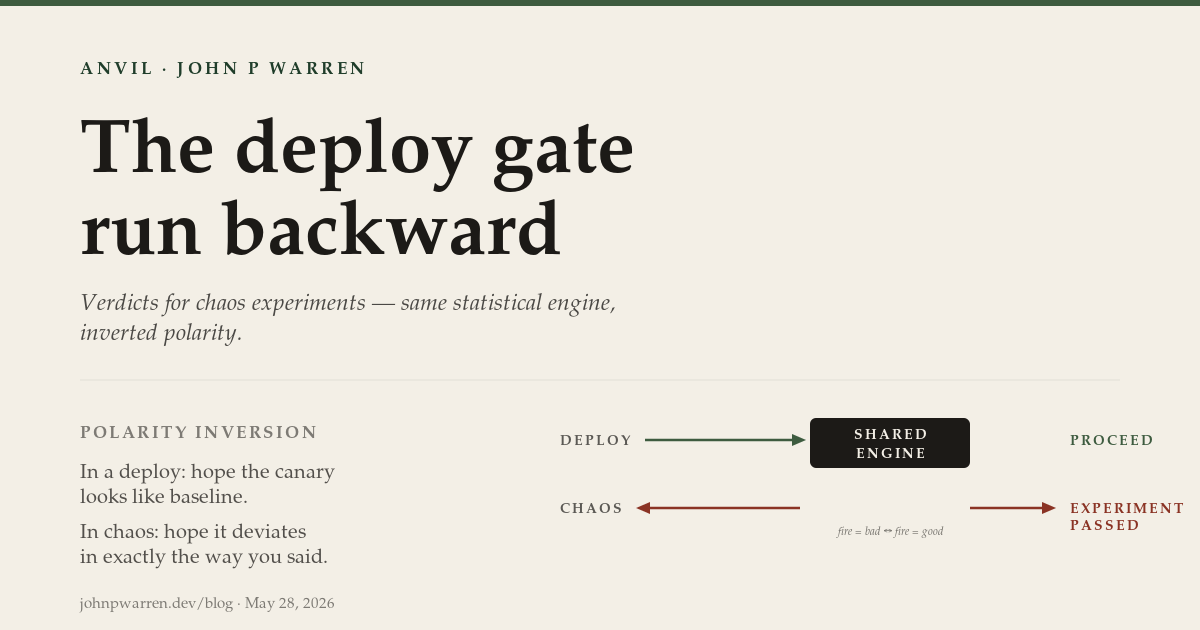
This is the third operational direction. Anvil runs the same engine against chaos experiments — and the polarity of “fire = bad” gets inverted along the way.
This is the fourth post in the series, and the shortest. The engine is already explained in the DeploySignal post; the methodology context is already established. The thing distinctive about Anvil is the operational inversion, and that’s what this post is about.
The chaos-verdict gap
Chaos-engineering platforms — Gremlin, Chaos Mesh, AWS FIS, Litmus — are good at injecting faults. They schedule the experiment, run it against the target, and produce a structured record of what happened. What they don’t produce is a structured verdict: did the system behave acceptably under the injected fault?
The verdict is left to an operator eyeballing dashboards. Did the latency spike recover in time? Did the dependent service degrade gracefully? Did anything unexpected happen during the fault window? The pass/fail call gets written into a postmortem document by hand, often days later, often by someone who wasn’t watching the run live.
This is the same gap deploy-gate tooling closed for deploys, run in the opposite direction. A deploy gate asks: “did the canary degrade compared to the baseline? If yes, rollback.” A chaos experiment asks: “did the system degrade only in the way I expected during the injected fault? If yes, the experiment passed; if it degraded in an unexpected way, the experiment failed and revealed a real weakness.”
The structural similarity is the load-bearing observation. Both are verdict problems against an anytime-valid statistical portfolio with formal false-positive guarantees. The difference is the operator’s prior: in a deploy, you’re hoping the canary looks like the baseline; in a chaos experiment, you’re hoping for a specific, declared deviation.
Anvil is the packaging that makes the engine run in that second direction.
The expected_failure_pattern contract
The key data structure is an ExpectedFailurePattern declared at experiment-start. The operator commits, before the fault is injected, to what the fault should do.
ExpectedFailurePattern {
  kind:             "latency_injection",
  affected_signals: ["p99_latency"],
  magnitude:        0.30,            // expected to rise by ≤30%
  magnitude_unit:   "fractional",
  recovery_seconds: 60,              // expected to recover within 60s post-fault
  suppress_families: ["A_p99_latency"],
}
The contract does two things at once. First, it gives the verdict a hypothesis to test against — “did p99 rise by ≤30% within the fault window and recover within 60s of fault end?” Without a pre-declared expectation, the verdict has nothing to verify against; it’s just measurement.
Second, it declares which detector families the expected fault would otherwise fire. In the latency-injection example, Family A’s per-signal sequential test on p99_latency is going to fire when latency spikes — that’s the fault doing its job. Suppressing A_p99_latency for the duration of the fault window means the verdict doesn’t read “rollback” simply because the operator’s intentional perturbation worked.
The verdict vocabulary maps from DeploySignal’s native one:
| DS verdict | Anvil verdict |
|---|---|
proceed | experiment_passed |
rollback | experiment_failed_unexpectedly |
extend | experiment_still_running |
The translation happens at the adapter boundary; the engine emits its native vocabulary, and the adapter rewrites it per DeployContext.strategy === 'chaos_experiment'. The Ville-bound on the α-participating portfolio holds exactly as it does in the canary direction. No detector math changes. Anvil is packaging, contracts, and vocabulary — not new statistics.
Family suppression and the unexpected blast
The structural point of suppression is to preserve the engine’s ability to fire on what the operator didn’t expect, while staying quiet about what they did.
In the latency-injection example: Family A on p99_latency is suppressed. Family A on every other signal — downstream_err, tool_success_rate, eval_score — is still running. Family C (joint vector) is still running. If the latency injection causes an additional downstream error spike, Family A on downstream_err fires. If the latency injection causes p99 and error rate to move in an unusually correlated way (a joint-distribution shift that no single-signal test would catch), Family C fires.
Either of those firings produces experiment_failed_unexpectedly — not because the operator’s intended fault didn’t happen, but because the system revealed a coupling the operator hadn’t accounted for. That is the chaos engineer’s actual signal of interest. The whole point of injecting faults is to find out what the system does other than the intended thing.
The Anvil v1 reference profile runs four families: A as primary (per-signal mean shift), C as the unexpected-blast catcher (joint-vector distance), D for oscillation and recovery, and E for novelty and distributional shift. The α allocation is 40/20/20/20, total budget 1e-3 — the same anytime-valid guarantee as in the deploy-gate direction. Family B is held at zero: its structural rules were tuned for LLM-inference signatures and don’t transfer to generic chaos targets, so its share is reserved rather than spent, pending chaos-structural signature work.
The four adapters
Anvil ships four chaos-platform adapters under engine/o0/anvil/:
engine/o0/anvil/
├── gremlin.ts
├── chaos-mesh.ts
├── chaos-mesh-translate.ts
├── aws-fis.ts
├── litmus.ts
├── suppression.ts
├── types.ts
└── index.ts
Each adapter implements two methods: fetchDeployContext(experiment_ref) (the standard orchestration-adapter contract) and fetchExpectedFailurePattern(experiment_ref) (the chaos-specific extension that pulls the experiment’s declared parameters from the platform’s API and shapes them into the ExpectedFailurePattern schema).
At v1, these ship as typed stubs with provenance docstrings citing the upstream platform’s experiment-definition API. The contracts are real; the end-to-end wire-up to each platform’s API surface is deferred to follow-on cycles. The bet being made: get the contract shape right, then wire each platform to it. Validating that bet requires operator partnership or substantive further build-out — neither of which is in scope for the v1 positioning play.
This is the honest framing of where Anvil sits today. The engine is real. The audit substrate is real. The verdict translation is real. The four platform adapters are typed stubs. The reference profile (profiles/anvil-chaos-experiment.yaml) is real. The end-to-end demonstration of a single platform integration end-to-end is a downstream cycle.
The DS-Anvil composition
Anvil isn’t a single component; it’s a composition. DS-Anvil draws on three:
- The DeploySignal engine at the verdict layer (Ville-bounded portfolio + audit substrate)
- Tessera at the per-shard observation layer
- The chaos-platform adapter family (Gremlin / Chaos Mesh / AWS FIS / Litmus)
Tessera matters for chaos in a specific way. A typical chaos experiment targets a topology subset: pod-kill on shard-04, network-partition on rack-2, latency-injection on a tenant subset. The fault is, by construction, topology-localized. Tessera’s per-shard residual semantics and topology-aware grouping already handle exactly this — and Tessera’s bi-directional integration with DeploySignal (engine/ds-integration/ HTTP contract) means the chaos event flows into Tessera’s freeze-hook naturally: Tessera knows to suppress per-shard alerts on shards inside the declared fault window.
Without Tessera, a cluster-scope chaos experiment generates noise on every shard the operator didn’t target. With Tessera, the verdict correctly says “shard-04 degraded as expected; the rest of rack-2 stayed within their hierarchical baselines.”
That composition is what makes DS-Anvil a coherent thing rather than three repos you’d have to manually integrate. The pieces share the same statistical substrate and the same contracts — wiring them up by hand would duplicate work the contracts already do.
Close
Anvil currently lands as positioning + contracts + adapter stubs + reference profile. The engine substrate is real; the verdict translation is real; the bundle composition is real. The four end-to-end platform integrations are not.
The four-product picture comes into focus here. DeploySignal answers “should this deploy proceed?” Anvil answers “did this chaos experiment fail in the way I said it would?” Tessera answers “is this shard behaving normally?” Cairn — coming up next — answers “what caused this incident?” Four operational questions, one statistical engine, one audit substrate, one methodology.
The methodology angle on Anvil is briefer than on the prior two posts because the disciplines have been told. The PRD lives in coordination/PRD-29-anvil.md. The spec lives in coordination/Q29-ANVIL-CHAOS-VERDICT-SPEC.md. The anti-scope is enumerated explicitly (no per-experiment detector retraining, no chaos-platform-side authoring UX, no live multi-tenant production chaos at v1, no fifth platform yet). The audit-record extension is replay-clean. The Ville-bound holds. The standard pattern.
The next post will be about Cairn, which closes the lifecycle loop in the original direction: when a regression escapes all three other systems and lands in production, Cairn ranks candidate cause-events against incident onset under a Bayesian alignment model. Different math again, same substrate, same methodology.